
Why the OM‑1 + 40‑150mm Pro + 1.4x TC is a Killer Softball Combo
Softball Photography With the OM‑1 and 40‑150mm Pro (With 1.4x TC) – Chasing the Perfect Ball‑on‑Bat Shot —- Click on my image below it will take you to my Album on Flickr 2026
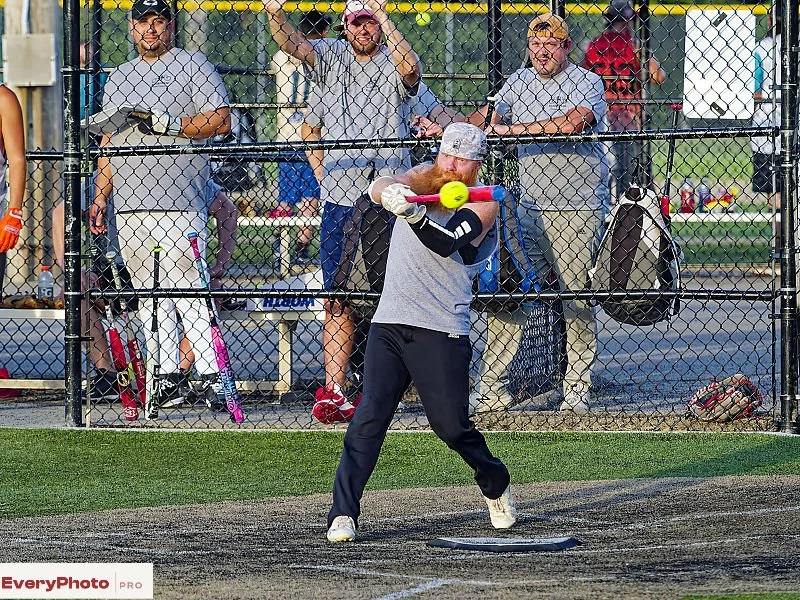
This is the best one I got out of 3000 shots >> Yea I know<<
If you’ve ever tried to photograph softball and nail that exact moment when the ball meets the bat, you already know it’s humbling. The swing is fast, the ball is small in the frame, and your timing can feel off by just a few frames every time. Add in the fact that you’re shooting with a high‑speed burst and a modern mirrorless body, and the learning curve can feel steep, even if you’re comfortable with action photography in other genres.
In this post, I’ll walk through how I’m approaching softball with the OM System OM‑1 and the M.Zuiko 40‑150mm f/2.8 Pro paired with the 1.4x teleconverter. I’ll share the settings and workflow I’m using right now, plus what I’m still refining as I chase that perfect ball‑on‑bat frame.
The OM‑1 is built for action. It offers fast stacked sensor readout, excellent continuous autofocus, and very high‑speed burst rates that are ideal for sports like softball where everything happens in a fraction of a second. Paired with the 40‑150mm f/2.8 Pro and the 1.4x teleconverter, you effectively get a 56–210mm f/4 lens, or roughly 112–420mm in full‑frame terms. That is a very useful range for infield coverage.
From the first or third base line, that focal length lets you comfortably frame batters, pitchers, and infielders without feeling too tight or too loose. From behind home plate, the longer end lets you isolate the batter and catcher while compressing the background nicely. The lens and teleconverter combo remains sharp wide open and focuses quickly, so you don’t have to choose between reach and responsiveness.
Core Exposure Settings for Freezing the Action
Softball is all about speed: the pitch, the swing, the ball’s movement off the bat. To freeze that motion cleanly, I prioritize shutter speed and let the OM‑1 handle ISO.
My baseline exposure approach:
Mode: Manual exposure with Auto ISO
Shutter speed: 1/2000–1/3200 second
Aperture: f/4–f/4.5
ISO: Auto, with a practical ceiling somewhere in the 6400–8000 range
Shutter speed is non‑negotiable here. Around 1/2000 second, you can stop the bat and ball noticeably better; at 1/3200 second you give yourself even more margin to freeze that tiny ball in midair. The trade‑off is ISO, but the OM‑1 handles moderate noise well, and for sports images, a bit of grain is vastly preferable to motion blur.
With the 1.4x teleconverter, your widest aperture is f/4. I generally stay there or stop down just a third of a stop if I want a touch more depth of field around the batter’s face and bat. Backgrounds at softball fields are usually messy, so a relatively shallow depth of field helps separate your subject while still keeping enough of the swing in focus.
Autofocus Strategy: Stop Chasing the Ball
One of the biggest mindset shifts for me was accepting that the camera isn’t going to “grab the ball” in autofocus and ride it into the bat. The ball is simply too small and moves too fast across the frame. Instead, I build everything around the batter.
Here’s the AF setup that has been working well:
AF mode: C‑AF (continuous autofocus)
AF target: A small cross or small cluster, not a huge zone
Subject detection: Either set to Human or turned off if it starts grabbing the catcher or umpire instead
AF sensitivity: Slightly conservative (around the neutral point) so it doesn’t jump to the background with small movements
My process on each pitch looks like this:
As the pitcher begins the motion, I place my AF point on the batter’s upper chest or helmet and start a half‑press (or back‑button) to engage continuous AF.
I keep that AF point glued to the batter as the pitch comes in, resisting the urge to chase the ball with the AF point.
Once I see the batter commit to the swing, I fire a controlled burst using the OM‑1’s high‑speed drive.
The key idea: I’m pre‑focusing and tracking the batter, not the ball. The ball passes through the plane of focus at the moment of contact. If my AF and timing are right, both the batter’s face and the ball are sharp in that decisive frame.
Making High‑Speed Burst Work for You
The OM‑1’s SH2 mode can fire at incredibly high frame rates. That’s a gift for softball, but it can also bury you in files if you just hold the shutter and pray. Instead of spraying, I aim for short, deliberate bursts around the moment of the swing.
A practical way to think about it:
At 25–50 frames per second, each frame is only 0.02–0.04 seconds apart.
The ball can travel a surprising distance in that tiny window. That means if your timing is off by even a fraction of a second, your “perfect” frame might be the ball just before or just after the bat.
To stack the odds in my favor, I focus on predictable timing:
I watch the batter over an entire at‑bat. Swings are more consistent than they look at first. Each player usually has a tell—a front foot plant, a shoulder rotation, or a hand movement that signals the start of their swing.
I start my burst a fraction of a second before I expect contact. I’m not waiting to see the ball touch the bat in the viewfinder—by the time you perceive that, it’s already passed.
The result is a run of frames where the ball approaches, meets, and leaves the bat. Somewhere in that sequence is the hero shot.
If you want to push it further, the OM‑1’s Pro Capture modes are worth experimenting with. Pro Capture SH2 can buffer frames as you half‑press, then record the ones right before you fully press the shutter. That can help if you consistently find you’re just a bit late on the action.
Where to Stand and How to Frame
Your position on the field changes everything: angle, background, subject size, and how much the ball moves across your frame at the moment of impact.
Here are a few positions I like and why:
First or third base line fence:
Great for side‑on views of the batter.
The bat sweeps across your frame rather than straight toward or away from you, which keeps the ball in a more consistent focal plane.
100–150mm on the lens (200–300mm equivalent) gives strong compositions from here.
Behind home plate (if you can shoot over or through the fence/backstop):
Offers classic batter‑pitcher‑catcher layers and a more dramatic angle on the ball coming in.
The longer end of the lens (150–210mm / 300–420mm equivalent) helps you isolate the batter without including too much distraction.
Wherever you stand, I think about two main things:
Can I keep a clean focus on the batter throughout the pitch and swing?
Does the angle give me a clear view of the ball as it approaches and meets the bat?
Side‑on angles where the bat is mostly crossing the frame, not pointing straight at me, tend to give more shots where the ball, bat, and face live in the same plane of focus.
Drills and Practice to Improve Your Hit Rate
Even with good gear and solid settings, capturing that perfect ball‑on‑bat frame takes repetition. The sport is unforgiving, and there’s no substitute for reps.
Here are a few ways to stack more practice into less time:
Warm‑up and batting practice
Before the game, players usually take warm‑up swings or batting practice. This is a goldmine for practicing without the pressure of “missing the play.” You can stand in a fixed spot, run through different shutter speeds, AF settings, and burst modes, and see how your timing feels.Single‑role sessions
During games, I’ll sometimes dedicate entire innings to one role: batters only, pitchers only, or base runners only. When you strip it down to just one type of action, your brain starts to anticipate that specific rhythm, and your keeper rate improves more quickly.Batting cages
If you have access to a local batting cage, that’s a perfect controlled environment. The swing and pitch distances are consistent, and you can shoot from one angle for a long stretch, really fine‑tuning your timing and seeing how small exposure or AF changes impact results.
After each outing, I’ll cull quickly and tag only the true keepers—especially those where the ball is well‑defined near or at contact. Then I look at the EXIF data. Which shutter speeds worked best? Where did AF succeed or fail? Which angle gave me the most usable ball‑on‑bat frames? Over time, patterns emerge, and it becomes easier to repeat your success.
Little Practical Details That Help
A few smaller things that have made the experience smoother with this setup:
Stabilization
At 1/2000–1/3200 second, you don’t need stabilization to avoid motion blur, but IBIS can still make your viewfinder steadier when you’re tracking a moving subject at 200mm‑plus. I usually leave it on unless I’m doing intentional pans at slower shutter speeds.Controlled bursts
SH2 can absolutely flood your cards and your culling process if you hold the shutter too long. I train myself to fire short, intentional bursts—about half a second or so—around the swing, then release. It’s enough frames to find the moment but not so many that every pitch turns into an editing marathon.Lens handling
The 40‑150mm Pro with the 1.4x teleconverter is still relatively compact compared to full‑frame 300–400mm solutions, which is a bonus when you’re moving around a field. I’ll often zoom in and out slightly between pitches to vary framing—tighter on faces and bat, then a bit wider to include more of the batter’s stance or nearby players.Storytelling variety
The ball‑on‑bat frame is the hero, but the full gallery benefits from variety. I like to mix in:Pitcher release shots with the ball just leaving the hand
Reactions in the dugout
Plays at the bases
Candid moments between innings
These support images make the one perfect contact shot feel like part of a larger story, which is especially useful if you’re building galleries for parents, players, or teams.
Where I’m Still Refining Things
I’m still actively experimenting with:
How aggressive I want to be with frame rate vs. file volume
When to lean on Pro Capture vs. classic high‑speed bursts
The ideal AF sensitivity to avoid the focus jumping to the background when players cross paths
But the core formula is staying consistent: fast shutter, batter‑centric autofocus, deliberate SH2 bursts, and field positions that keep the bat sweeping across the frame. When all of those line up, the odds of getting that softball frozen right at the moment of impact go way up.
If you shoot softball with similar or different gear, what’s the one change that gave you the biggest jump in your keeper rate on ball‑on‑bat shots?
